Email Us

Why a 6x6 Off-Road Truck Makes Sense When the Job Gets Tough

You have probably seen a 4x4 work truck bounce through a muddy construction site or crawl over rocky terrain. That is the standard image of "off-road capable." But what happens when the mud gets deeper, the load gets heavier, and the terrain stops being a challenge and starts being a genuine obstacle? That is where the conversation shifts from 4x4 to 6x6 — and for a growing number of fleet managers, mining operators, and expedition planners, the answer is increasingly clear.


A 6x6 off-road truck is not just a 4x4 with an extra axle bolted on. It is a fundamentally different machine. The third axle changes everything: how weight is distributed, how traction is maintained on loose surfaces, and how much payload you can realistically carry without sinking or bogging down. As the global expedition truck market continues to expand — valued at USD 264.29 million in 2025 and projected to reach USD 443.25 million by 2034 at a CAGR of 5.91% — it is worth understanding what sets these vehicles apart and where they actually earn their keep.


Where the Third Axle Changes the Math?

When you add a third driven axle, you are not just adding two more wheels. You are adding ground contact, which spreads vehicle weight across a larger footprint. On soft soil, mud, or sand, that can mean the difference between crawling through and stopping dead. Testing of 6x6 platforms has shown that they can match or even exceed the off-road mobility of comparable 4x4 vehicles while carrying significantly heavier payloads — and in some cases demonstrate noticeably better performance specifically in soft soils, mud, and bogs.


Payload is where the gap really widens. A modified Ford Ranger HEX 6x6, for instance, can handle payloads of up to 3,800 kg — a figure that surpasses not only the standard Ranger but also the F-150 and even the Ford F-350. That extra capacity is not a luxury feature. In mining, construction, and military logistics, it translates directly into fewer trips, lower fuel consumption per ton moved, and less site congestion.


A Truck That Shows Up in Surprising Places


People tend to associate 6x6 trucks with military convoys, but the reality in 2026 is much broader. These chassis show up in industries that share one common thread: the work happens far from paved roads.


Mining and Heavy Industry

This is the most obvious application. Open-pit mines and remote quarries demand vehicles that can carry ore, overburden, or heavy equipment up steep gradients on surfaces that range from loose gravel to deep mud. Fleet operators in tier-one mining operations report that off-road capability to access remote locations is not a nice-to-have — it is essential. A truck that cannot reach the site is not a truck at all.


Construction and Infrastructure

Major civil projects — dam construction, pipeline laying, highway building through mountainous terrain — require reliable material transport before roads even exist. A 6x6 dump truck or cargo variant can deliver aggregates, steel, and equipment to staging areas that would stop a highway truck within the first hundred meters.


Emergency Response and Firefighting

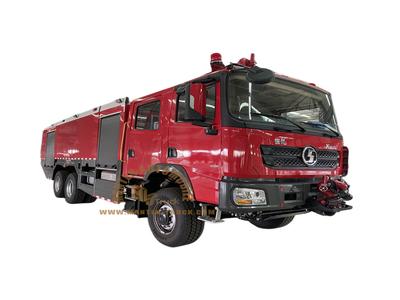
When wildfires spread across rugged terrain or floods wash out access roads, standard emergency vehicles often cannot get close enough. 6x6 chassis are increasingly used for off-road fire trucks, mobile command centers, and disaster relief supply vehicles that need to operate independently of road infrastructure.


Expedition and Overland Travel

The expedition segment deserves its own mention. Purpose-built overland vehicles on 6x6 platforms are becoming the backbone of a growing outdoor lifestyle movement, especially in markets like North America, Australia, and parts of Africa. These are not recreational toys — they are self-contained living and working platforms designed for extended journeys where resupply is measured in days or weeks, not hours.


Military and Defense Logistics

The military connection remains strong, but it is evolving. Modern defense procurement increasingly favors platforms that can serve both military and civilian roles — a concept sometimes called "dual-use" design. The new DAF 6x6 military truck shown at BEDEX 2026, for example, is offered with both a ballistic armored cab and a standard civilian cab, reflecting the reality that defense and industrial needs often overlap.


A Quick Look Across Industries


The table below gives a snapshot of how 6x6 trucks map to different sectors:


Industry

Typical Application

Key Requirement Met by 6x6

Mining & Quarrying

Ore haulage, equipment transport

High payload on steep, unsealed grades

Construction

Material delivery to remote sites

Off-road access before roads are built

Oil & Gas

Rig support, fuel & water transport

Reliability in desert and arctic conditions

Firefighting

Off-road fire trucks, water tenders

Access to wildfire zones via rough terrain

Military / Defense

Cargo, troop transport, logistics

All-terrain mobility with heavy loads

Expedition / Overland

Long-range self-supported travel

Payload for living systems, fuel, and water

Humanitarian Aid

Disaster relief supply delivery

Operation independent of road infrastructure


What Actually Matters When Specifying a 6x6?


Not all 6x6 trucks are built the same way, and the spec sheet tells only part of the story. Based on feedback from fleet operators and procurement managers across several industries, here are the factors that tend to separate trucks that work from trucks that cause headaches.


Chassis and Drivetrain Quality. The chassis is the foundation — literally. In heavy-duty applications, a reinforced steel frame with proper rust-proofing matters more than horsepower numbers. Manufacturers based in industrial hubs with deep automotive supply chains, such as Shiyan in Hubei Province (often called the "Truck Capital of China"), tend to have better access to quality component suppliers and engineering talent.


Drivetrain Configuration. Full-time 6x6 with locking differentials on all three axles offers the best traction in severe conditions. Some trucks also feature hub reduction gearing, which reduces stress on the axle shafts and improves torque delivery to each wheel. A two-speed transfer case with a dedicated low range is essential for crawling over obstacles or pulling heavy loads up steep inclines.


Engine and Transmission Pairing. Horsepower figures grab attention, but torque — and where in the rev range it arrives — matters more for off-road work. Engines in the 350–450 hp range paired with a 12-speed or 16-speed automated manual transmission are common in medium- to heavy-duty 6x6 configurations. The transmission needs to handle sustained low-speed, high-load operation without overheating.


Payload vs. Real-World Capacity. Payload ratings on paper do not always reflect what a truck can carry on a 15% gradient through loose shale. Experienced buyers look at gross vehicle mass (GVM) and gross combination mass (GCM) figures alongside real-world reports from similar operating conditions.


Customization and Body Integration. A 6x6 chassis is often just the starting point. Dump bodies, water tanks, fuel bowsers, crane mounts, troop carriers, mobile workshops — the superstructure defines the truck's actual utility. Working with a supplier that offers in-house engineering support for custom body integration can save months of downtime and compatibility headaches.


After-Sales Support and Parts Availability. This is the factor that first-time buyers most often overlook. A truck that cannot be serviced quickly is a liability. Supplier responsiveness, parts inventory, and dealer or service partner networks in the country of operation should be part of the evaluation from day one.


4x4 vs 6x6: When the Extra Axle Justifies Itself


A 4x4 truck handles the vast majority of off-road tasks just fine — until it does not. The decision to go 6x6 usually comes down to three thresholds: payload weight, terrain severity, and trip frequency.


A 6x6 conversion provides traction, balance, and durability that a standard 4x4 simply cannot match in severe-duty work. Because weight is distributed across six contact patches instead of four, ground pressure per wheel decreases, reducing the likelihood of sinking in soft ground. And when one wheel loses grip, five others are still driving — a redundancy that proves its worth the moment conditions deteriorate.


The comparison below breaks down the key differences:


Factor

4x4 Off-Road Truck

6x6 Off-Road Truck

Driven Wheels

4

6

Ground Contact Patches

4

6

Typical Payload Range

1,000–5,000 kg (light to medium duty)

5,000–40,000+ kg depending on chassis class

Traction on Soft Ground

Good

Superior — weight spread over larger area

Redundancy (loss of one wheel's grip)

Limited — 25% traction loss

Better — only ~17% traction loss per wheel

Maneuverability (tight spaces)

Better — shorter wheelbase

Reduced turning radius; harder in confined areas

Fuel Consumption

Lower

Higher — extra drivetrain friction and weight

Acquisition Cost

Lower

Higher — but often lower cost-per-ton moved

Best Suited For

Light off-road work, smaller payloads

Heavy haulage, severe terrain, continuous operation


What Experienced Buyers Look For?


Procurement managers who buy 6x6 trucks regularly tend to follow a structured process that goes well beyond comparing price tags. Certifications matter — ISO 9001 for quality management, CE marking for European conformity, or regional equivalents like CCC in China signal that a manufacturer follows established production and safety standards.


Production capacity is another filter. A supplier that can demonstrate consistent output volumes, reasonable lead times, and the ability to scale with your fleet growth is worth more than a lower upfront quote from a smaller operation that may struggle with repeat orders.


Communication quality during the inquiry stage often predicts the relationship quality after delivery. Suppliers who respond promptly, provide detailed technical documentation, and offer pre-shipment inspection reports tend to deliver a smoother overall experience.


One piece of practical advice from seasoned buyers: ask for chassis and engine bay photos of a completed build similar to your specification, not just a brochure. If a supplier cannot show you real examples of their work, that is worth noting.


For those sourcing from China — which remains the dominant force in heavy-duty vehicle manufacturing for specialized applications — the industrial cluster in Hubei Province offers particular advantages. The region's dense network of component suppliers, R&D centers, and established OEMs supports everything from standard configurations to fully customized builds designed for specific operational environments.


Making the Call


A 6x6 off-road truck is not the right tool for every job. If your routes are mostly paved and your loads fall comfortably within single-axle capacity, a 4x2 or 4x4 will serve you well at a lower purchase and operating cost. But if you regularly find yourself pushing the limits of what a 4x4 can carry over ground that barely qualifies as a road, the math starts tilting toward the extra axle — and fast.


The key is to evaluate honestly: what are you hauling, where are you taking it, and how often? Answer those three questions with real data, and the right chassis configuration tends to reveal itself.


Frequently Asked Questions


1. What is the typical payload capacity of a 6x6 off-road truck?

It depends heavily on the chassis class. Light-duty 6x6 pickups may handle 1,700–3,800 kg, while heavy-duty cargo and dump configurations regularly carry 30 to 40 tons — and some mining-spec articulated haulers go even higher. Always check gross vehicle mass (GVM) and gross combination mass (GCM) ratings, not just the advertised payload figure.


2. Can a 6x6 truck be used on normal highways?

Yes — most 6x6 trucks are road-legal in their respective markets, provided they meet local emissions, lighting, and dimensional regulations. However, highway fuel consumption will be higher than a comparable 4x2 or 6x4 truck due to the additional drivetrain drag, and top speed may be lower depending on gearing.


3. How does fuel consumption compare between a 4x4 and a 6x6?

A 6x6 will burn more fuel per kilometer on paved roads — typically 10% to 20% more than an equivalent 4x4, depending on weight, engine tune, and tire selection. The trade-off is that in off-road conditions where a 4x4 would require multiple trips, a single 6x6 trip often uses less total fuel to move the same tonnage.


4. What maintenance items require more attention on a 6x6?

The additional axle means more differential oil to change, extra brake components to inspect, and one more driveshaft to monitor for wear. Tire rotation is also more involved — six tires instead of four, and uneven wear across the rear axles is common if alignment is not checked regularly. On the plus side, many drivetrain components are shared with proven 4x4 platforms, keeping parts availability reasonable.


5. Are 6x6 off-road trucks available in right-hand drive?

Yes. Manufacturers serving markets in Australia, the UK, parts of Africa, and Southeast Asia routinely offer right-hand drive configurations. If you require RHD, confirm this with your supplier early in the inquiry process — it affects production scheduling and may influence lead times.

Related Manten Trucks
Manten Trunks Latest News & Blog
Trucks
ROOM 603, BLOCK 1, FANHAI SOHO BUILDING,JIANGHAN DISTRICT, WUHAN ,CHINA